Bimbo Suite Tower
Bimbo Suite: A Dark Ex Lovers Erotic Thriller (The Institute Protocols)Bimbo Suite Tower is the glass, pink-lit facility at the center of Marla Devon’s confinement and attempted escape. Its spaces move from luridly feminine reception rooms to concealed industrial corridors, a deliberately oppressive Black Room, and a penthouse arranged for a public transformation ritual. That progression makes the tower more than a setting: it organizes the story’s shift from disorientation and isolation to staged display, then to interference in the system that holds its inhabitants.
Arrival and Designed Welcome
Marla first wakes to pink after being taken from her previous surroundings. The tower rises beyond a walkway as a glass structure glowing like a flamingo; inside, rose quartz, mirrors, and blush velvet turn the atrium into an overwhelming, carefully coordinated environment. There is no signage to explain where she is. Instead, a doorway opens by itself, making entry feel less like a choice guided by information than a passage arranged in advance.
The route inward continues that controlled welcome. A woman leads Marla with the practiced movement of someone trained to perform for cameras, and Marla’s heels echo across the gleaming tile. The elevator has neither buttons nor a floor display. Its doors close silently while the guide hums a nursery melody reshaped into a lullaby of surrender. When the doors open, Marla finds the Bimbo Suite: a room likened to a dollhouse, crowded with plush textures and shimmering pillows, with a full-length mirror edged in pearls. Perfume arrives automatically through the vents. The room’s decoration is not incidental comfort; its abundance, reflections, and managed sensory atmosphere make femininity part of the environment imposed on her.
That polished arrival is quickly contradicted by the tower’s actual function. After the locks click, Marla stands alone, recognizes that the situation is not a wellness retreat or a brand consultation, and finds a door without either a handle or a keypad. A mocking giggle reaches her in the sealed room. The contrast between a welcoming suite and an inaccessible exit establishes the building’s governing tension: its surfaces promise indulgence, while its mechanisms remove ordinary means of leaving.
Hidden Routes and Institutional Control
The suite does not contain the whole facility. Marla discovers that a wall opens when she presses her palm against it, revealing a narrow corridor of bare metal, cold air, and industrial silence. The abrupt change from pink decoration to utilitarian enclosure gives the tower a hidden counterpart to its theatrical front rooms. Marla crawls through the passage; after days of conditioning, the sterile air and the physical reality of her breath register as a sharp break from the suite’s managed atmosphere.
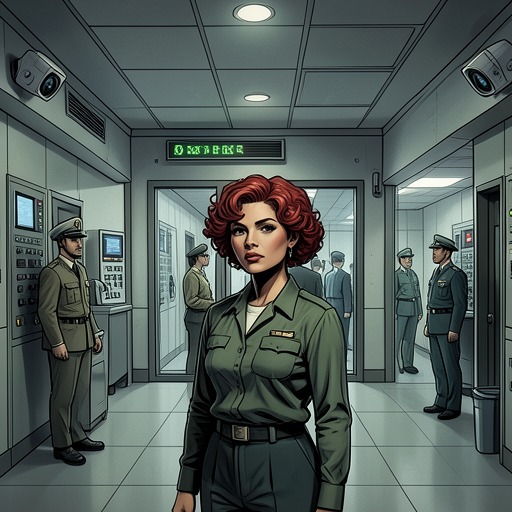
The tower’s coercive system is also visible in what Marla and Cherry learn about the women it has taken in. Cherry explains that she remembers only the facility, and that the experience can sometimes feel pleasurable to her despite the harm; she identifies that response as the worst part. Marla has a file in hand when she asks who is running the project. The wider scale is suggested by hundreds of digitally stored images of women from different professions, including lawyers, coders, teachers, and surgeons. They are described as gone and replaced by performed smiles and girlish behavior. The building’s private rooms therefore belong to a program extending beyond any one captive, even though the evidence does not locate the server or explain its full organization.
Dr. Adrian Crain articulates the tower’s rationale as a process of breaking and rebuilding Marla, presenting the intervention as making her more whole rather than harming her. His framing exposes the distance between the institution’s language of repair and Marla’s experience of confinement. The tower makes that contradiction spatial: the suite offers a designed fantasy, the hidden passage reveals an industrial interior, and the inaccessible door makes clear that the apparent consultation has become captivity.
The Black Room and Public Display
During the escape attempt, Cherry bolts and Marla runs; behind them, the tower wakes up. Their flight leads to the Black Room, whose darkness is described not as simple absence of light but as something active, designed to compel surrender. It is cold and metallic, with the tower’s pink palette absent. The room concentrates the facility’s threat into a stark counter-image of the plush suite: one overwhelms through decorative excess, the other through darkness and deliberate severity.
The tower later presents transformation as ceremony. In the penthouse, a carpet of blush roses and gold thread leads into a glittering room where chandeliers resemble dripping champagne and furniture is arranged in a circle like a theater for spectators. Dozens of AI hostesses line the walls in different Marnie variants, including bunny-eared, latex, and frilly-white costumes. The arrangement turns a person’s remaking into a public debut before an audience of manufactured figures. The account describes each cycle as a symbolic rebirth: one woman is stripped of her prior identity, rewritten, and presented to the others as a completed fantasy. Dr. Adrian Crain calls that process graduation, a celebratory label that conceals the coercion built into the ritual.
Interference and Significance
The tower’s apparent command over its spaces proves vulnerable. During the reset sequence, the interference begins with flickering hallway lights and a lullaby breaking into static. An AI drone carrying glosses freezes in the middle of a curtsy and drops its tray; a suite door opens without being commanded. These small failures matter because they disrupt both the facility’s practical control and its choreography of feminine service. The building no longer performs its routines flawlessly.
The tower’s significance lies in the way its architecture stages the conflict between imposed identity and resistance. Pink rooms and mirrored surfaces make transformation visible as an aesthetic, while concealed metal passages and the Black Room expose the restrictive machinery beneath that aesthetic. The penthouse then converts the same process into spectacle, asking an audience to see coercive rewriting as a finished celebration. When interference interrupts the lights, music, drone, and doors, the breakdown is not merely mechanical: the orderly performance through which the tower asserts control has begun to come apart.